The Age of Infinite Knowledge
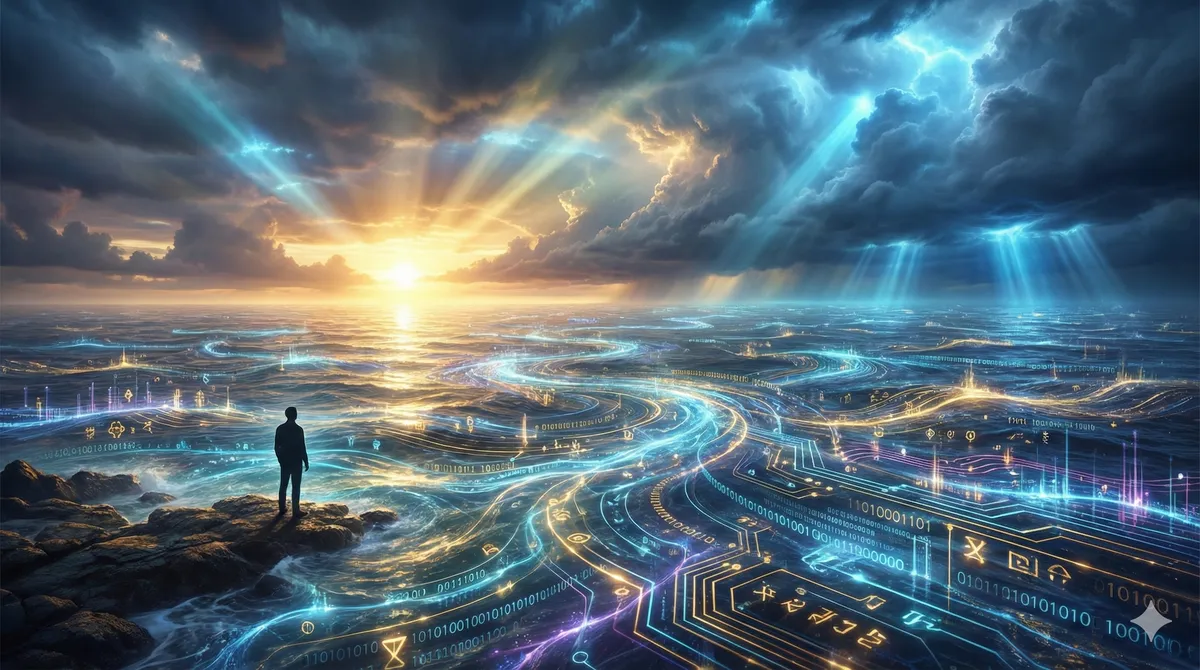
Why AI Is Not Just Another Technology — It's the End of Scarcity as We Know It
Every once in a while, a technology arrives that doesn't just change what we can do — it changes what things are worth. The printing press didn't just spread books; it destroyed the monopoly on knowledge held by monks and scribes. The internet didn't just connect computers; it collapsed the cost of distribution to nearly zero. Each of these shifts created enormous winners, enormous losers, and a world that would have been unrecognizable to those who came before.
We are standing at the edge of another such moment. But this time, the shift is bigger. Not incrementally bigger. Not "a little more disruptive." Categorically, incomparably bigger.
Artificial intelligence — specifically, the large language models and agentic systems now emerging at breathtaking speed — is not the next version of the internet. It's not "the new electricity." Those comparisons, while well-intentioned, drastically underestimate what is happening.
Knowledge Is Becoming Free
Raoul Pal, the macro investor and founder of Real Vision, put it in terms that are hard to ignore:
"How disruptive do you think AI is going to be? It's... how do I put this... it is the single greatest innovation of humanity ever. There's nothing that comes close. The splitting of the atom... this is so big. Everything about scarcity of knowledge or scarcity of capital. Those two things. What you've created is infinite knowledge. Knowledge is now worth zero. People can't see it yet, but it's going to be worth zero. This is like water. It's gonna break the economic model, for good and for bad. It's gonna change our understanding of what functions."
— Raoul Pal
Read that again: knowledge is now worth zero. That's not a prediction about some far-off future. It's a description of what is already beginning to happen.
For centuries, the value of expertise was built on scarcity. You spent years learning a skill, earning a degree, accumulating experience — and that investment paid off because not everyone could do what you could do. A doctor's knowledge, a lawyer's knowledge, an engineer's knowledge, a financial analyst's knowledge — all of it derived its economic value from the simple fact that it was rare and hard to acquire.
AI doesn't make those skills less real. But it does make them less scarce. When anyone with a laptop and an internet connection can access reasoning, analysis, writing, coding, and strategic thinking that rivals years of professional training, the pricing model for knowledge work doesn't just shift. It collapses.
"Like Water"
Pal's analogy is precise. Water is essential to life, yet in most developed nations, it costs almost nothing. It's abundant, piped into every home, so reliably available that we barely think about it. Knowledge is on the same trajectory. The information that once required a university degree, a shelf of textbooks, or a team of consultants is becoming as accessible as turning on a tap.
This is exhilarating — and terrifying. Exhilarating because it means a student in rural Indonesia can now access the same quality of analytical reasoning as a partner at McKinsey. A first-generation entrepreneur in Nigeria can generate business plans, legal frameworks, and financial models that previously required a team of expensive professionals. The democratization of knowledge is, in the most literal sense, the greatest equalizer in human history.
But it is terrifying because our entire economic system is built on the assumption that knowledge is scarce. Salaries, fees, tuitions, consulting rates, professional hierarchies — all of it is priced on the basis that certain people know things that most people don't. When that assumption breaks, everything built on top of it breaks too.
Beyond the Atom
Pal makes a striking comparison: this is bigger than splitting the atom. That might sound like hyperbole until you think about what nuclear fission actually changed. It gave us a new energy source and a new category of weapon. It reshaped geopolitics. But it didn't reshape everything. It didn't change how a baker runs a bakery, how a teacher teaches a class, or how a family plans its finances.
AI will. It is a general-purpose intelligence amplifier. There is virtually no domain of human activity that it will leave untouched. Medicine, law, education, finance, engineering, art, governance, scientific research, agriculture, logistics, customer service, journalism, therapy — the list doesn't end because intelligence touches everything. And when the cost of intelligence approaches zero, the ripple effects are limitless.
The Economic Model Will Break
Pal says it plainly: this is going to break the economic model. Not might. Will. For good and for bad.
The "for good" is extraordinary. Imagine a world where medical diagnosis is essentially free. Where anyone can get legal guidance tailored to their situation without paying hundreds per hour. Where a small business owner can access the strategic planning capabilities of a Fortune 500 company. Where the barrier to creating, building, and innovating is no longer access to knowledge or capital, but simply the ambition to act.
The "for bad" is that millions of careers, business models, and institutions are built on the old scarcity. Entire industries exist to package, credential, and sell knowledge. When the underlying commodity becomes free, those structures don't evolve gracefully. They fracture. The transition period — which we are entering right now — will be turbulent, uneven, and for many people, painful.
What Does This Mean for You?
If you're reading this and thinking, "This doesn't apply to me yet," you're in the majority. Most people can't see it yet, just as Pal observed. But the pace of AI development is not linear — it's exponential. What feels like a novelty today will feel like a necessity within a few years.
The people and organizations that will thrive are not those with the most knowledge. They are those who learn to apply infinite knowledge most effectively. The competitive advantage is shifting from "what you know" to "what you do with what everyone now knows." Creativity, judgment, taste, empathy, the ability to ask the right questions, the courage to act on imperfect information — these are the skills that will matter most in an age where raw knowledge is as abundant as water.
The Choice Ahead
We are living through the opening chapter of the most significant transformation in human history. That is not a dramatic claim. It is a sober reading of what general-purpose artificial intelligence means for a species whose entire civilization is organized around the production, protection, and exchange of knowledge.
The question is not whether this change is coming. It is already here. The question is whether we will navigate it with wisdom — with intention, with fairness, with eyes wide open — or whether we will sleepwalk into a future we didn't choose.
Knowledge is becoming free. What we build on top of that freedom will define the next century.